
Digital Service Discovery
Business Solution Finder
Helping organizations translate business challenges into clearer technology solution paths.
Organizations often understand the operational friction they want to address—such as manual work, outdated systems, or cloud migration—but may not know which technology service or architectural pattern is best suited.
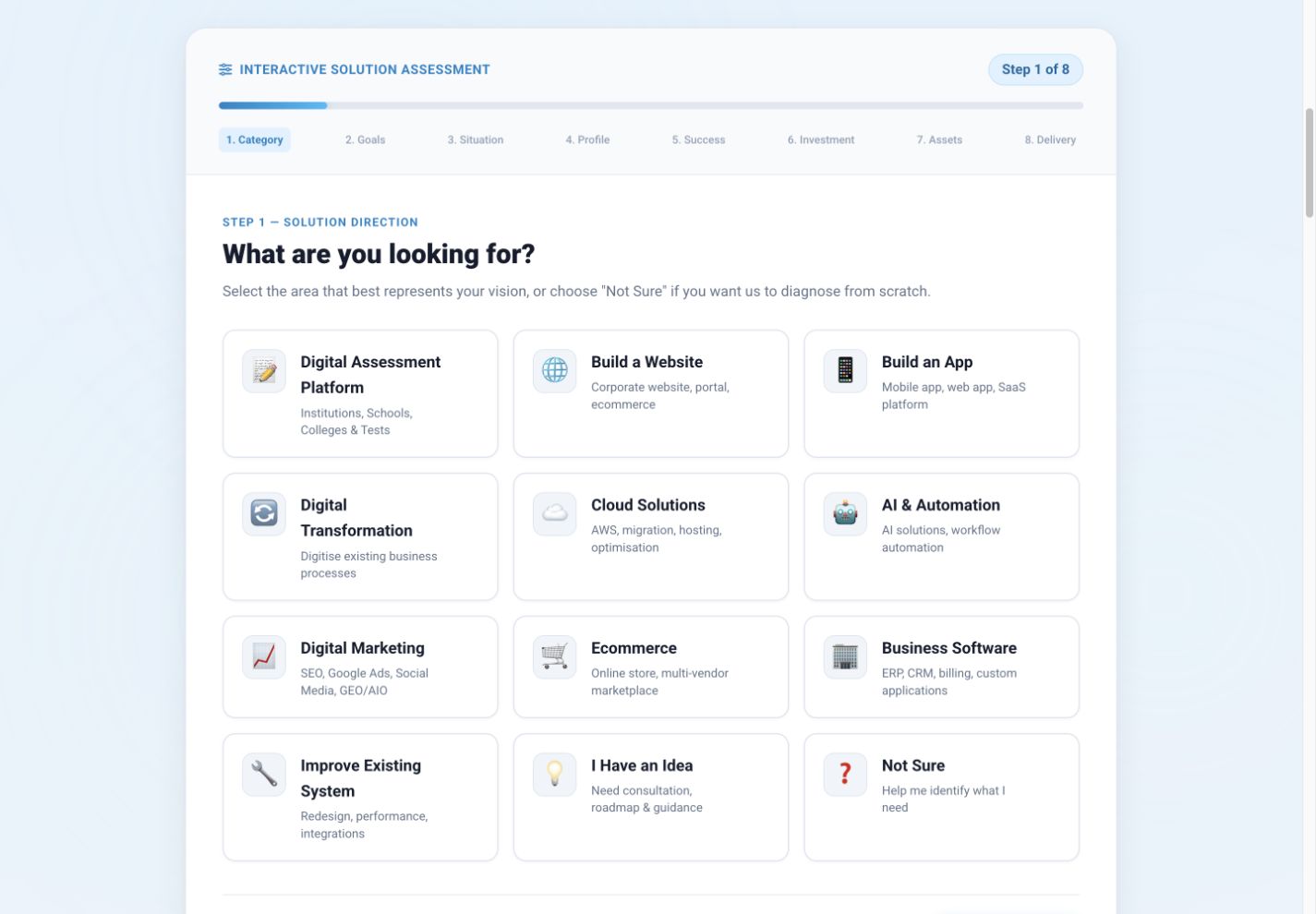
SunSolv developed the Business Solution Finder, a responsive diagnostic web application built with Angular Reactive Architecture that helps decision-makers explore and clarify their technical requirements.
Through a guided discovery questionnaire across 12 operational categories, the application evaluates user priorities and suggests focused solution tracks with concrete next steps.
The Operational Challenge
Bridging the Gap Between Business Problems and Technical Scoping
Business users describe problems in operational terms: reducing administrative time, improving customer experience, connecting siloed applications, or modernizing legacy software. Translating those operational needs into a clear technical scope often requires extensive early discovery.
Without a structured framework, initial discussions frequently stall on ambiguous requirements, leading to prolonged scoping discussions and delayed project initiation.
Vocabulary Mismatch
Business leaders articulate goals in operational terms, while engineering teams require functional parameters.
Ambiguous Initial Briefs
Generic web forms fail to collect sufficient context regarding operational workflows, integration needs, and scale.
Protracted Scoping Cycles
Multiple introductory sessions were often needed just to identify which engineering practice area a project fell under.
Premature Technology Selection
Organizations risked committing to specific tools before clarifying whether their challenge required custom development, cloud modernization, or process automation.
Operational Context
How Requirements Scoping Typically Operated
Traditionally, organizations seeking technology services begin by submitting basic contact inquiries or scheduling unstructured introductory calls. Inquiries often arrive with minimal context, such as asking for "an automation system" without specifying user workflows or existing software integrations.
Consulting teams were required to conduct repetitive exploratory calls simply to categorize requests and determine whether cloud migration, custom software, or process automation was appropriate before drafting an initial scope.
Structural Operational Constraints
- Freeform inquiries provided inconsistent information for evaluating technical feasibility and project scope.
- Decision-makers had limited visibility into alternative architectural patterns that could address their operational friction.
- Multi-week delays often occurred between initial inquiry submission and receiving an aligned technology roadmap.
- Hesitation by prospective clients to share detailed internal systems context on unguided web forms.
Implementation Philosophy
Structuring a Guided Discovery Journey
SunSolv structured the discovery approach around a progressive diagnostic journey: Business Need → Diagnostic Questions → Context → Technology Options → Suggested Solution Path.
The experience is designed to support initial discovery and help users frame problems clearly. Complex technology decisions still benefit from deeper consultation, and the tool serves as an interactive starting point rather than a replacement for engineering advisory.
Problem-First Framing
Start with the organizational outcome the user desires rather than asking them to select an engineering discipline.
Adaptive Context Questions
Present lightweight, conditional questions tailored specifically to the operational domain selected by the user.
Client-Side Privacy Controls
Run the diagnostic flow in browser memory; user responses are not stored in tracking databases during questionnaire exploration.
Actionable Next Steps
Provide immediate architectural context and synthesize a structured brief that can directly inform subsequent consulting conversations.
Delivered Architecture
A Responsive, Reactive Diagnostic Web Application
SunSolv engineered a responsive diagnostic application using Angular Reactive Architecture. The application guides users through an interactive 12-category discovery questionnaire, evaluates their answers against defined architectural patterns, and synthesizes tailored service recommendations with concrete next steps.
The interface maintains instant responsiveness, providing real-time visual progress as users refine their requirements. Upon completion, users receive a synthesized project overview that cleanly translates operational challenges into technical tracks.
Application Capabilities
Core Diagnostic and Recommendation Features
Interactive 12-Category Discovery
Enables decision-makers to explore priorities across custom software, cloud readiness, legacy modernization, AI adoption, and workflow automation.
Adaptive Diagnostic Questions
Dynamically branches into focused operational questions that capture system scale, user counts, and integration needs.
Requirements Mapping Engine
Maps identified business challenges to appropriate engineering disciplines and delivery tracks based on defined architectural patterns.
Structured Brief Synthesis
Consolidates user selections into an actionable project brief highlighting recommended technology services and delivery priorities.
In-Memory Client-Side State
User responses remain in client-side component memory during the discovery steps without persistent tracking databases or advertising cookies; details are only transmitted if the visitor chooses to submit an enquiry.
Structured Consultation Handoff
Enables users to carry their synthesized diagnostic summary directly into project inquiry submissions for focused initial discussions.
Process Architecture
The Discovery-to-Action User Journey
How the application guides users from initial challenge exploration through to actionable project scoping.
- 01
Category Selection
Operational FocusDecision MakerChoose from 12 operational domains including modernization, cloud, software, or AI.
- 02
Context Diagnostics
Operational QuestionsDecision MakerAnswer contextual prompts detailing current systems, team size, and integration points.
- 03
Priority Calibration
Timeline & ScaleDecision MakerIndicate delivery urgency, compliance constraints, and expected user scale.
- 04
Pattern Evaluation
Architecture MatchingEngineEvaluate entered criteria against established architecture patterns and delivery models.
- 05
Track Recommendation
Tailored ServicesEngineSynthesize primary and secondary technology tracks best suited to the operational need.
- 06
Brief Synthesis & Action
Consultation BriefUser & AdvisoryExport or submit the structured brief to initiate focused engineering scoping.
Delivery Methodology
A Focused Engineering Process
- 01
Discover
Catalog common business challenges across client inquiries and establish a taxonomic model mapping organizational problems to technology disciplines.
- 02
Define
Design the diagnostic questionnaire flows, decision-tree branching logic, in-memory state contracts, and recommendation synthesis rules.
- 03
Deliver
Develop the reactive Angular application, responsive interaction flows, real-time brief generator, and privacy-preserving client architecture.
- 04
Evolve
Evaluate user interaction patterns, refine diagnostic questions based on user clarity, and continuously update recommended technology tracks.
Operational Benefits
Delivered Capabilities and Operational Value
Clearer Requirements Upfront
Prospective clients frame their operational needs with greater structure, reducing ambiguity in early conversations.
Accelerated Scoping Conversations
Initial consulting sessions start with an established baseline of constraints, scale, and recommended technology services.
Transparent Self-Service Exploration
Decision-makers explore potential technology tracks independently and comfortably before initiating formal discussions.
Privacy-Preserving User Experience
In-memory state management ensures visitors explore options without premature data persistence or tracking friction.
Strategic Takeaway
Clarity at the Point of Entry
Early clarity in software and consulting engagements substantially reduces scoping cycles. By providing a guided, privacy-first diagnostic experience, organizations can translate complex business challenges into structured technical roadmaps before committing engineering resources.
Connected Capabilities
Explore Related Expertise & Context
Discover the services, sector context, and technical insights connected to this solution.
Primary Services Involved
IT Consulting
Technology strategy, enterprise architecture reviews, and actionable implementation roadmaps.
Custom Software Development
Bespoke software platforms engineered around specialized organizational workflows.
Digital Transformation
Modernize operational processes, eliminate bottlenecks, and connect disparate systems.
Related Technical Insights
What Should a Technology Discovery Workshop Deliver?
Covers the diagnostic framework used to unearth underlying operational constraints before proposing software architecture.
How to Build a Practical Technology Roadmap
Guides how multi-phase technical roadmaps prioritize high-impact capabilities while controlling delivery risk.
AI vs Automation: Which Does Your Business Actually Need?
Explains why transparent, deterministic logic was chosen over probabilistic AI models for consistent diagnostic recommendations.
Build With SunSolv
Have a Similar Operational Challenge?
Explore how SunSolv can engineer a dependable, customized solution tailored to your organization's specific workflows, constraints, and operational goals.