
Education Technology
Digital Assessment Platform
A structured digital workflow for assessment creation, delivery, evaluation and reporting.
Managing assessments across multiple programs involves question authoring, test scheduling, candidate participation, grading, and grade reporting.
SunSolv engineered a centralized web assessment platform built with Angular, TypeScript, and Node.js that brings assessment creation, test delivery, rubric evaluation, and score reporting into a coherent workflow.
The platform separates administrative oversight from student testing and faculty evaluation, creating a dependable, responsive environment for academic operations.
The Operational Challenge
Overcoming Fragmented Academic Examination Workflows
Academic institutions and training organizations frequently coordinate testing across disparate spreadsheets, document templates, email threads, and independent grading sheets.
This operational fragmentation increases the risk of paper handling errors, introduces scheduling bottlenecks, and delays result turnaround for students and administrators.
Disconnected Authoring & Storage
Questions authored in independent documents made peer review, categorized versioning, and question reuse difficult.
Manual Exam Scheduling
Coordinating test sessions, candidate cohorts, and time slots required tedious manual transcription across spreadsheets.
Vulnerable Delivery Environments
Online tests lacking local state autosave risked candidate response loss during intermittent network disruptions.
Delayed Grading & Consolidation
Subjective evaluation performed on physical forms required manual tallying and re-entry before institutional results could be published.
Operational Context
How the Process Operated Before Implementation
Prior to implementing a centralized assessment platform, examination processes were split across distinct administrative silos. Faculty members drafted questions in local text documents and emailed them to department chairs for compilation.
Administrative staff manually compiled test papers, distributed schedules via noticeboards or separate portal announcements, and collected physical or form-based submissions. Following testing, instructors graded answer scripts individually, calculated scores manually, and submitted physical ledgers to registrars for final tabulation.
Structural Operational Constraints
- Lack of centralized question versioning and difficulty preventing unauthorized distribution prior to test sessions.
- High administrative labor hours required to assemble, schedule, and distribute unique assessments across different student cohorts.
- Risk of progress loss for candidates experiencing client-side connection drops during timed examinations without local state recovery.
- Multi-week turnaround times to manually grade subjective answers, compute aggregate statistics, and publish official records.
Implementation Philosophy
Structuring Around the Complete Assessment Lifecycle
SunSolv structured the solution around the complete assessment lifecycle rather than simply digitizing a paper exam.
Instead of viewing an examination as a one-time isolated test form, the architectural approach models the continuous operational flow from question-bank curation through assessment assembly, secure delivery, collaborative rubric-based evaluation, and institutional reporting.
Lifecycle Continuity
Connect each stage so that approved questions directly populate assessments, student submissions flow directly to evaluators, and finalized scores immediately update reporting ledgers.
Resilient Test Sessions
Implement local state autosave to help preserve candidate progress against temporary network interruptions.
Role-Based Clarity
Provide distinct, distraction-free interfaces tailored to the exact responsibilities of Administrators, Authors, Students, and Evaluators.
Structured Evaluation
Combine instant automated scoring for objective questions with standardized rubric guidelines for descriptive answers.
Delivered Architecture
A Unified Digital Platform for Academic Operations
SunSolv engineered a responsive web application built with Angular on the frontend and Node.js with relational data storage on the backend. The platform provides unified interfaces for question bank management, dynamic assessment creation, automated time enforcement, secure student participation, and standardized evaluator review.
Role-based access controls ensure that faculty members access authoring and grading tools, administrators manage candidate registries and scheduling parameters, and students participate in focused, timed testing sessions with immediate confirmation.
Platform Capabilities
Core Capabilities Supporting the Examination Workflow
Question-Bank Management
Author, tag, and categorize questions across multiple formats including multiple-choice questions (MCQs), coding challenges, and structured short-answer questions.
Assessment Configuration & Scheduling
Define total duration, sectional time limits, question randomization, passing criteria, and scheduled testing windows.
Student Assignment & Cohort Controls
Allocate tests to predefined classes or specific candidates with individual access tokens and attendance tracking.
Secure Timed Delivery with Autosave
Provide students with a clean, focused testing interface featuring real-time countdown enforcement and local state autosave to help recover responses if disconnected.
Rubric-Based Evaluation & Score Computation
Enable evaluators to review descriptive submissions against standardized rubric criteria while automated scoring handles objective question types.
Institutional Grade Reports & Export
Generate class performance analytics, grade distributions, and downloadable CSV/Excel ledgers for registrar systems.
Role-Based Authorization
Enforce strict permission boundaries separating Super Administrators, Institution Coordinators, Faculty Authors, Evaluators, and Students.
Process Architecture
The End-to-End Assessment Workflow
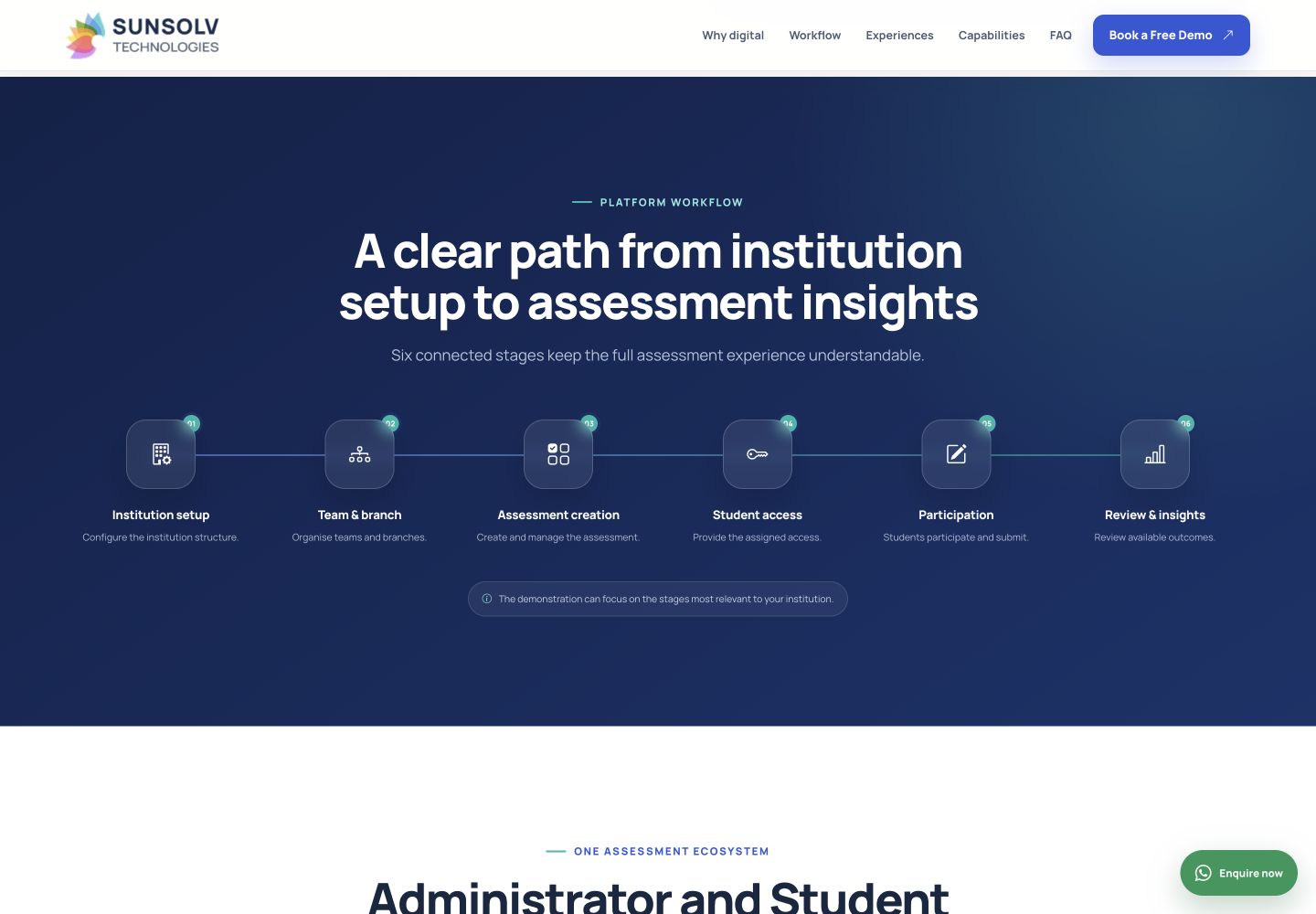
The platform connects the complete lifecycle from institutional setup through review and reporting.
- 01
Institution & Program Setup
Administrative OnboardingAdminConfigure institutional settings, academic departments, and grading rules.
- 02
Team & Faculty Allocation
Role & Subject AssignmentCoordinatorDesignate subject leads, question authors, and assigned evaluation faculty.
- 03
Assessment Configuration
Bank Selection & TimingFaculty AuthorSelect question modules, set time limits, and define scoring rubrics.
- 04
Cohort & Access Control
Student EnrollmentCoordinatorAssign eligible student batches, generate unique access keys, and schedule windows.
- 05
Examination Delivery
Timed Candidate TestingStudentComplete timed tests with automated state preservation and countdown timers.
- 06
Evaluation & Reporting
Rubrics & PublicationEvaluator / AdminGrade subjective responses, compile cumulative statistics, and export transcripts.
Delivery Methodology
A Phased Implementation Approach
- 01
Discover
Engage academic stakeholders to map existing examination guidelines, rubric structures, question formats, and cohort scheduling requirements.
- 02
Define
Establish data models for multi-format questions, state recovery architectures, timing constraints, and permission boundaries across user tiers.
- 03
Deliver
Engineer the responsive Angular interface, robust Node.js backend services, local autosave mechanisms, and rubric evaluation dashboards.
- 04
Evolve
Gather evaluator feedback, analyze session timing patterns, refine rubric grading workflows, and optimize high-concurrency performance.
Operational Benefits
Delivered Capabilities and Operational Value
Centralized Administrative Control
Institutions manage question curation, scheduling, and results from a single secure environment rather than scattered documents.
Streamlined Examination Turnaround
Automated objective scoring and standardized rubric tools substantially accelerate grading cycles for faculty and students.
Resilient Testing Experience
Local autosave reduces the impact of intermittent client connectivity disruptions during live examination sessions.
Auditability and Grade Governance
Comprehensive audit logs for submissions, evaluations, and score revisions ensure transparency throughout academic grading.
Strategic Takeaway
Process Continuity Over Point Tools
Educational technology succeeds when it treats assessment as a continuous academic workflow rather than an isolated testing event. Connecting question curation, secure delivery, structured rubric evaluation, and institutional reporting creates a dependable operational foundation for educators and students alike.
Connected Capabilities
Explore Related Expertise & Context
Discover the services, sector context, and technical insights connected to this solution.
Primary Services Involved
Related Technical Insights
How Digital Assessment Platforms Can Improve Education Workflows
Explores the workflow architecture required to connect authoring, exam administration, grading, and reporting into one unified platform.
How Schools Can Structure a Reusable Digital Question Bank
Explains how modular curriculum taxonomies and cognitive depth tagging preserve faculty effort and enable fair student evaluations.
Custom Software vs SaaS: How Should Businesses Decide?
Analyzes why strict institutional security and evaluation workflows often justify bespoke software over off-the-shelf software.
Build With SunSolv
Have a Similar Operational Challenge?
Explore how SunSolv can engineer a dependable, customized solution tailored to your organization's specific workflows, constraints, and operational goals.